English
At our school, English is positive, inspiring, and empowering. We view reading, oracy, knowledge-building, and writing as one continuous, interconnected journey, where every step enriches and strengthens the next.
Our Shared Vision
As a staff team, we create an environment where children feel enthusiastic, supported, motivated, and successful. We deliver an English curriculum that:
-
Engages all learners through high-quality modelling and adaptive teaching.
-
Builds strong foundations in composition, SPaG, handwriting, pencil grip, and the confident sharing of work.
-
Prioritises verbal feedback, enabling immediate improvement and active celebration of progress.
-
Encourages children to feel inspired, take risks, and develop their unique voice as writers and readers.
How Learning Connects: The Reading and Writing Journey
Great writing relies on a rich foundation of knowledge, language, and reading experience. Rather than teaching these elements in isolation, we weave them together so that every lesson builds directly towards confident, independent writing.
Knowledge as the Catalyst for Writing
Before children can write effectively, they need rich content to write about. We deliberately draw upon the deep knowledge pupils gain across our foundation subjects—such as History, Geography, and Science. By grounding writing tasks in familiar, high-leverage topic knowledge, children can focus their cognitive energy on sentence structure, ambitious vocabulary, and composition rather than struggling for ideas.
The Foundation of Reading and Phonics
Fluent reading unlocks the ability to write. From Early Years, we use the Little Wandle Letters and Sounds Revised programme to build secure phonetic knowledge and early decoding skills. As pupils gain fluency, they progress seamlessly to whole-class texts—exposing them to sophisticated literary structures, rich vocabulary, and diverse genres—before developing into independent, passionate readers.
Oracy as the Bridge to Written Expression
Talk is the bridge between reading a text and writing one. Children must be able to articulate their thoughts before they can write them down. Through structured debate, drama, and verbal rehearsal, pupils test out new vocabulary, experiment with sentence patterns, and refine their ideas aloud before taking pen to paper.
Our Instructional Sequence: Collect, Connect, Create, Publish
This fluid link between reading, talk, and writing is put into practice through our four-stage learning sequence.
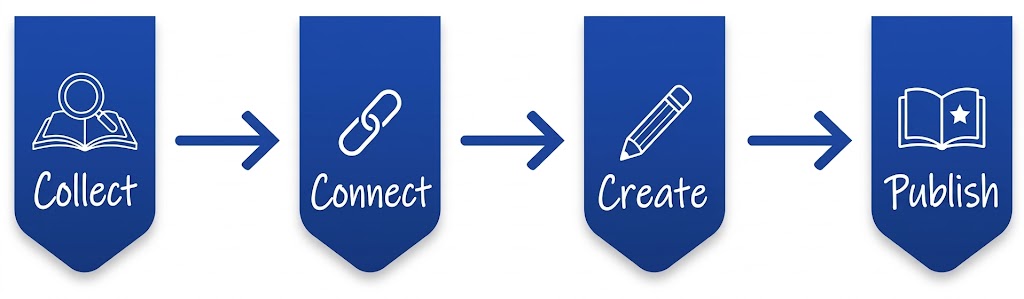
Collect
Writing begins with immersion. Children explore rich texts and analyse high-quality WAGOLLs (What A Good One Looks Like) to understand how expert writers craft their work. Through drama, talk, and guided research, pupils gather rich vocabulary, language techniques, and key subject knowledge.
Includes: Reading rich model texts, vocabulary building, subject knowledge, experiences, oracy, and exploration.
Connect
Pupils take the vocabulary and ideas they have gathered and begin shaping them into coherent sentences. Through oral rehearsal and targeted grammar practice, children learn to manipulate sentence structures, refine their punctuation, and organize paragraphs logically for their intended audience.
Includes: Oral rehearsal, sentence construction, grammar, punctuation, paragraphing, and planning.
Create
Armed with rich reading models and oral practice, children draft and compose their writing. During this stage, we prioritize immediate verbal feedback, allowing pupils to edit, adapt, and refine their work live in the classroom using targeted writing checklists.
Includes: Drafting, composing, applying skills, editing, improving, and responding to feedback.
Publish
The process culminates in children publishing their work for a real purpose and audience—such as writing for an author, a school visitor, peers, or the wider community. Pupils focus on presentation, handwriting, and celebrating the independent application of their skills.
Includes: Presenting writing appropriately, considering audience, accuracy, and celebrating progress.
Each new unit begins the cycle again: reading enriches talk, talk shapes thinking, thinking drives writing, and successful writing deepens reading comprehension.
Phonics in EYFS & KS1
At St Paul’s C of E we follow the Little Wandle Letters and Sounds Revised programme. This is a phonics resource that has been accredited by the Department for Education and Skills which consists of five phases.
To support early reading development, we support our phonics programme with a range of early reading books. These reading books are all phonetically decodable and carefully matched to children's ability. This allows children to practise the skills for early reading. Children have regular, discreet reading sessions in school and an opportunity to read their phonics books at home.
We also encourage parents to get involved with this key aspect of their children's education and invite parents to a Phonics Morning, supporting parents with their understanding of phonics and ways to support their children at home. We also offer stay and play sessions that allow parents to come and get involved in their children's learning in school in a fun and practical way.
Phonics LTP
Supporting your child at home.
To help you support your child at home, here are some pronunciation guides and videos.
Autumn 1 Phase 2 sounds
Phase 2 Sounds taught in Reception Autumn 1
Autumn 2 Phase 2 sounds
Phase 2 Sounds taught in Reception Autumn 2
Spring 1 Phase 3 sounds
Phase 3 Sounds taught in Year 1
Here is a quick guide to alien words
Guide to alien words
Here is a video about how we teach tricky words.
Tricky Words
Autumn 1 Sounds
Autumn 2 SoundsSpring 1 Sounds
Phonics and Early Reading Policy
Reading Book Support for Parents
KS1 Reading Books KS2 Reading Books
SPAG Glossary
English Page


